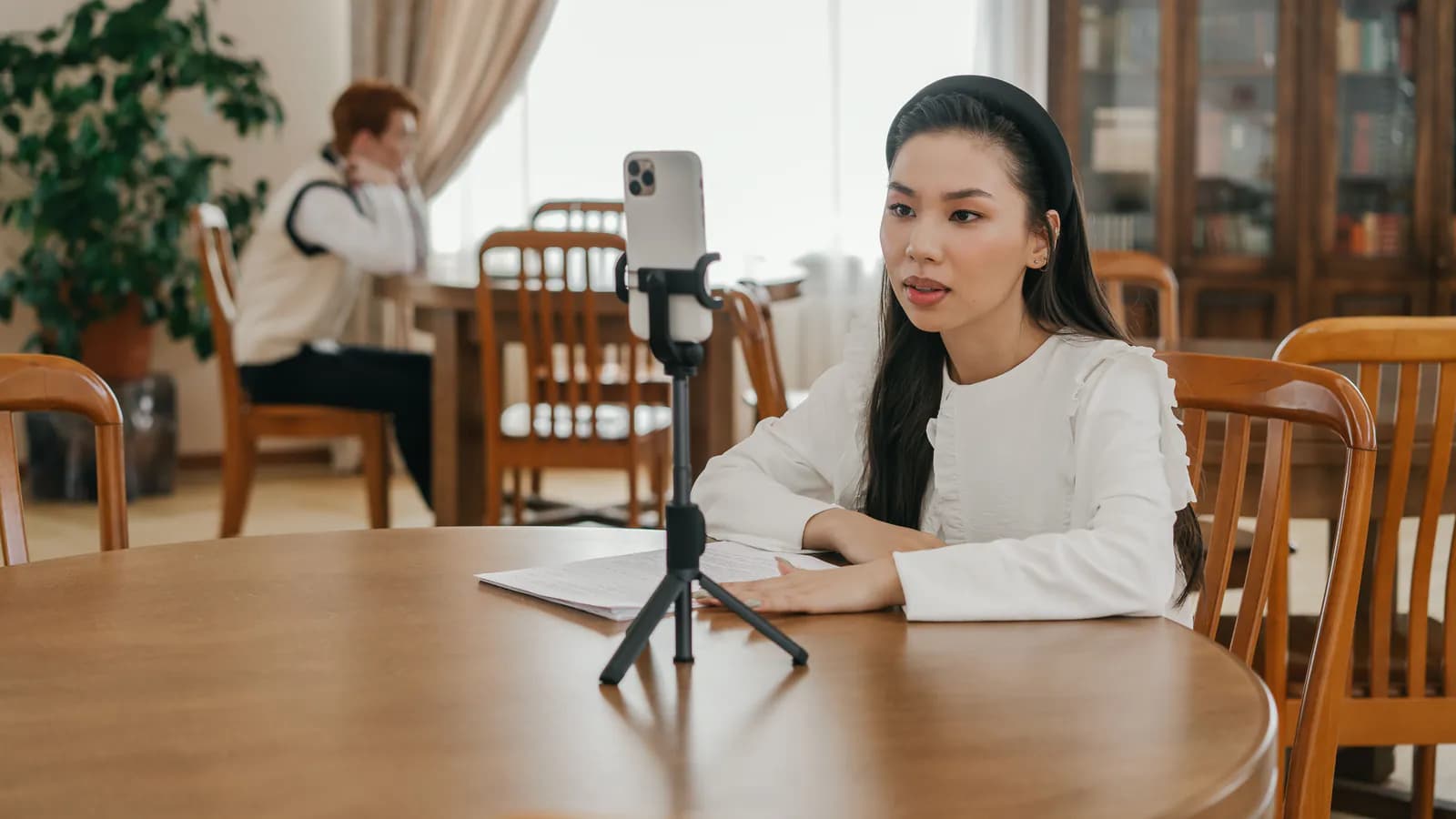
How to shoot Reels on your phone: 9 rules for a professional result

The product is good and the service works, but the person who opens the Reel never finds that out — the frame shakes, the face sits in shadow, the audio sounds far away, and the thumb moves on after three seconds. The problem isn't the product. It's the shoot.
The good news: none of the nine points below need an expensive camera. An average phone is already capable enough — what's missing isn't gear, it's doing the same small things every time. The points fall into three groups: framing and light, audio and shooting logic, consistency and planning. Each one names what breaks the result and what to change this week.
Framing and light
1. Hold the phone still, not just in your hand
Handheld footage always carries a small shake, and on a close shot — especially on a phone screen — that shake reads larger than it feels while filming. Viewers don't name it, but they read it as "thrown together," and that impression tends to attach to the business, not just the clip. The fix is simple: a small tripod, a stack of books, a wall to lean against. If you're filming handheld, use both hands and tuck your elbows in — the shake drops noticeably.
2. Light the face, not the background
Film with a window behind you and the phone exposes for the brightest part of the frame — the window — leaving the face dark or silhouetted. The result: viewers can't see who's talking, and they finish the video less often. The fix takes a second: face the window instead of standing with your back to it, so the light sits behind the camera, not behind you.
3. Skip digital zoom — move the phone instead
Pinching to zoom on a phone doesn't bring the lens closer optically; it crops and stretches the image, which is exactly why zoomed footage looks soft and grainy. On a close-up product shot that flaw is the first thing a viewer notices. Move the phone physically closer to the subject instead — the framing stays the same, and the quality doesn't drop.
Audio and shooting logic
4. Record the sound close to the source
A phone's built-in microphone picks up the whole room — the air conditioner, the street, the echo — at the same level as the voice. Even with a sharp picture, muffled or distant audio loses a viewer faster than weak video does, because most people watch Reels with the sound on. Keep the phone or a clip-on mic 30–40 cm from whoever's speaking, close the window, and avoid a room that faces the street if you can.
5. Shoot more footage than the final cut needs
When one shot runs for the whole clip, there's nothing to cut to if a section falls flat — no backup angle exists. The result plays like a single unedited take and loses interest quickly. Film the same scene from two or three angles — a wide shot, a close-up on the product, a close-up on hands at work — and grab a few seconds of silent cutaway footage: packaging the item, pouring a coffee, opening a door. That's what saves you in the edit.
6. Keep clips short and cut on movement
A shot where nothing changes feels longer than its actual runtime. What holds attention is something new appearing every two or three seconds. Instead of relying on one long take, plan several short segments and cut right as a hand or body starts to move — the transition reads as natural motion instead of an obvious splice.
Consistency and planning
7. Write the first three seconds before you film
A video that opens with "Hi, today I wanted to tell you about..." makes people wait, but the decision to keep watching or scroll on happens in the first moments — before the actual message arrives. A slow opening loses the audience before it's said anything. Before you record, write down the opening line or shot on paper — start with the strongest visual or a direct question, not a greeting.
8. Clean the background and shoot in the same light
When every post is filmed somewhere different, in a different light, a profile reads as unplanned — as if five different people were running it. Pick one or two fixed shooting spots — the same window, the same wall — and film at roughly the same time of day or under the same ring light. The background doesn't need to change for the videos to look like they belong to one brand.
9. Lock focus and exposure by hand
The moment something moves through frame — someone walks past, the light shifts for a second — the phone hunts for a new focus point and brightness, and the picture visibly "breathes." Viewers won't name the cause, but they notice that something looks technically off. Before you press record, tap and hold on the speaker's face — that locks focus and exposure, and the frame stays stable for the rest of the take.
What to check against these nine
- A problem in framing and light (1–3) — the video looks unprofessional before the viewer has heard a single word, no matter how good the product is.
- A problem in audio and shooting logic (4–6) — nothing is left to cut to in the edit, and the video drags.
- A problem in consistency and planning (7–9) — a single video can still turn out well, but the profile as a whole never reads as one brand.
The camera doesn't change the result — repeating these nine steps every time does.
Repeating nine steps every month — script, shoot, edit, a separate cut for each platform — takes real time. If that time is the constraint, our content shoot and production team takes the process from script to finished video, and the footage stays yours.